
The Truth of the Hanoi Marathon: Where 2:47:52 Becomes a ‘Queen’ — And Stays 21 Minutes Behind the Olympic Standard
**कोर उत्तर (≤60 शब्द):** VPBank हनोई इंटरनेशनल मैराथन 2026 में महिला विजेता फाम थी होंग ले ने 2:47:52 और पुरुष विजेता हुइन्ह अन्ह खोई ने 2:31:49 का समय लिया। दोनों समय ओलंपिक मानक (महिला 2:26:50, पुरुष 2:08:10) से लगभग 21–24 मिनट पीछे हैं, यानी घरेलू-एलीट स्तर, अंतरराष्ट्रीय-एलीट नहीं। **मुख्य तथ्य:** - महिला विजेता फाम थी होंग ले का 2:47:52 विश्व रिकॉर्ड 2:09:56 (शिकागो 2024) से 37:56 पीछे है। - पुरुष विजेता हुइन्ह अन्ह खोई का 2:31:49 विश्व रिकॉर्ड 2:00:35 (शिकागो 2023) से 31:14 पीछे है। - टूटा ‘रिकॉर्ड’ कोर्स रिकॉर्ड है; पिछले VPIM समय 2:53:57 (2025) से 6:05 सुधार। - कोर्स तीन पुलों (लॉन्ग बिएन, न्हात तान, डोंग चू) और 30+ लैंडमार्क से गुज़रता है। - रात 1:30 बजे शुरुआत, 11,000+ धावक, चार दूरियां (42.195/21/10/5 किमी)। **स्रोत:** VPBank Hanoi International Marathon 2026 आयोजक रिकैप (VPIM 2026), AIMS-प्रमाणित कोर्स का दावा (स्वतंत्र सत्यापन नहीं)। **संबंधित प्रश्न-उत्तर:** प्रश्न: क्या VPIM 2026 का कोर्स रिकॉर्ड राष्ट्रीय रिकॉर्ड है? उत्तर: नहीं, यह केवल कोर्स रिकॉर्ड है, व्यक्तिगत सर्वश्रेष्ठ या राष्ट्रीय रिकॉर्ड नहीं। प्रश्न: VPIM 2026 के विजेता समय ओलंपिक मानक से कितने दूर हैं? उत्तर: महिला 21:02 और पुरुष 23:39 पीछे (पेरिस 2024 मानक के संदर्भ में)। प्रश्न: रात 1:30 बजे की शुरुआत प्रदर्शन को कैसे प्रभावित करती है? उत्तर: यह सर्केडियन गर्त (सुबह 3–5 बजे) के करीब पड़ती है, जिससे कोर टेम्परेचर और न्यूरोमस्कुलर तैयारी कम रहते हैं।
It is 1:30 in the morning. Cold air moves across the 120-year-old steel truss of the Long Bien Bridge, and below it the Red River keeps flowing in the dark. At the far end of the bridge are more than 11,000 pairs of shoes — some carbon-plated, some ordinary, some borrowed. There is no starting pistol, only a wave signal, and the crowd begins to move. I am watching this live stream on a laptop in Mumbai, 7,000 kilometres from Hanoi, my tea gone cold, and this is the moment I realise I am not witnessing an elite championship — I am watching the pulse of a city's body.

The results arrive the next morning. Pham Thi Hong Le wins the women's race in 2:47:52 — about 3:59 per kilometre. Huynh Anh Khoi wins the men's race in 2:31:49 — 3:36 per kilometre. The organisers' press release calls Le ‘the queen of the running track,’ and within Hanoi's domestic circuit that is not wrong. But when I open my notebook and set these two numbers against the world's standards, the temperature of the story changes.
Both winning times sit roughly 21 to 24 minutes outside the Olympic marathon standard — a full competitive tier below. And that is the central tension of this report: a city presenting its marathon to the world, and a clock telling us how wide the gap is between a domestic ‘queen’ and the global ‘elite.’

Context
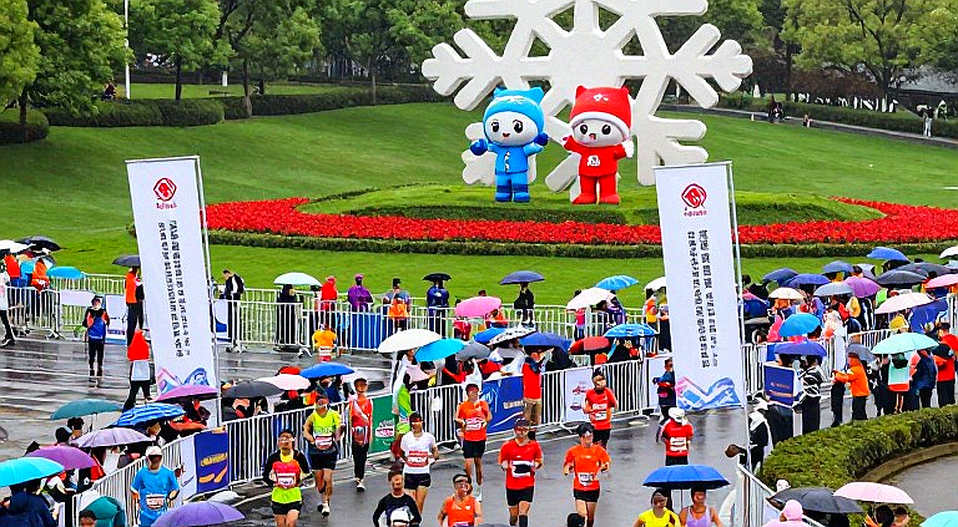
I have tracked Asia's road-racing circuit for several years now. In 2026, when I opened my notebook in Bhubaneswar and the athletes wrote themselves in, I formed a habit — to read every race by its institution first and its medal later. I read VPIM 2026 the same way. This is not a World Athletics Label elite road race; it is a mass-participation event, bank-sponsored, with a course claimed to be AIMS-certified, though that certification is not independently verified. Besides the 42.195 km there are 21, 10 and 5 km supporting races, and more than 11,000 runners go off in four separate waves.
The geography of the course is the event's identity: three bridges — the century-old steel truss of Long Bien, and the modern cable-stayed spans of Nhat Tan and Dong Tru — then the Ho Chi Minh Mausoleum, the Thang Long Imperial Citadel, the Flag Tower and the city's three lakes. The 2026 edition has changed its identity too — a new ‘Pixel Art / Hanoi Vibes’ branding, which suggests the organisers have rethought not just the date but perhaps the route.
Two things are worth remembering in this context. First, marathon running has no wind-legality rule and no altitude adjustment; what actually changes the result are humidity, start time, and the climbs and descents of the bridges. Second, this race is not relevant to World Athletics ranking, so something like a ‘season ranking’ simply does not apply here. What remains is local performance, the local economy, and the signal of a road-running ecosystem. And that is why this race should be measured not by a qualification window but by the breath of the city that gave birth to it.
Core analysis
Now to the numbers the organisers' release left out of the brackets.
The women's winning 2:47:52 is 37 minutes 56 seconds away from the world record of 2:09:56 (Ruth Chepngetich, Chicago 2026). The men's winning 2:31:49 is 31 minutes 14 seconds away from the world record of 2:00:35 (Kelvin Kiptum, Chicago 2026). These figures do not tell us about anyone's weakness — they tell us about level. The distance between domestic-elite and international-elite here is measured not in minutes but in half-hours.
The comparison with the Olympic standard sharpens the picture. Against the Paris 2026 reference, the women's Olympic standard was 2:26:50 — a gap of 21 minutes 2 seconds. The men's was 2:08:10 — a gap of 23 minutes 39 seconds. The Tokyo 2026 World Championships women's standard of 2:23:30 is further still. These numbers make it clear that VPIM's winning time is strong domestically, but stops well before reaching the threshold of international qualification. That is not contempt; it is a map.
The men's race deserves a separate look, because the story there is slightly different. Huynh Anh Khoi's 2:31:49, or 3:36 per kilometre, is a solid time in Vietnam's domestic circuit, yet invisible at world level in the same way. The interesting detail is that the men's and women's winners are only 23 seconds apart per kilometre — which by itself tells us that both races were swimming at roughly the same depth. To call either one ‘strong’ would be to ignore the other.
Here is a subtlety the release blurred. The ‘record’ that fell is a course record — not a personal best and not a national record. Le improved her own previous VPIM time of 2:53:57 (2026) — a jump of 6 minutes 5 seconds, about 3.5 percent. At this level a single-year jump that large is an event in itself, and calling it pure ‘athletic progression’ would be a mistake. Several things are mixed in: a possible route change, the weather, pack dynamics, and training. When the course itself changes, crediting the improvement only to the lungs is not honest.
The course — this is the part promotional language hides most. Forty-two kilometres across three bridges, one a 120-year-old steel truss and two cable-stayed spans with long approach viaducts, means real elevation gain, ramp gradients, wind exposure on open spans, and repeated surface transitions — steel, concrete, asphalt, stone. A net elevation drop is what invalidates a record; gain merely slows the field. So the release's ‘golden weather = fast times’ line is advertising, not analysis. In my notebook I have written this course down as a ‘slowing course,’ and alongside that entry a question — if the course is not that fast, who is the real hero of 2:47:52?
The weather needs to be addressed directly. Autumn in Hanoi usually sits in the 20–24°C band, but at night relative humidity climbs above 80 percent. In a marathon the biggest enemy of thermoregulation is not temperature but humidity — even at moderate temperature, 80 percent humidity stops sweat from evaporating and the body cannot cool. ‘Ideal weather’ is the organiser's claim, not a measured fact.
And then the time — the 1:30 a.m. start. I treat this not as performance optimisation but as a logistics solution. Staging more than 11,000 runners across four distances on closed city roads requires an extremely long operational window, and a pre-dawn start also dodges Hanoi's daytime heat. But it carries a hidden cost: it pushes the elite race close to the body's circadian trough — when core temperature is at its lowest and neuromuscular readiness at its least, roughly between 3 and 5 a.m. This is a real, under-discussed performance tax that no press release writes about.
The marathon's real examination is not in the first 21 kilometres but in the last 10 — and a 1:30 a.m. start makes that last 10 the hardest. Runners who would normally produce a negative split in a daytime race (second half faster than the first) tend to spend their glycogen in the first half on this schedule. I do not have the official splits for this race, but the 3:59 per kilometre average combined with the three-bridge structure suggests the winning time was probably built on an even or mildly positive split — the second half slower than the first. This is where the night start and the bridge climbs send the bill together.
In all this accounting there is one thing I write at the very top of my notebook: the economy of participation. A sponsor like VPBank is the real ‘professional contract’ of this sport in Vietnam — just as, in India, jobs with the Railways, the Services and the state police are athletics' actual salary. The entry fees, T-shirts, medals and a tourism week of 11,000 people — that is the money that buys the next generation's shoes. The athlete who finishes a marathon in 4:30 never appears on a results wire, yet is the base of this sport. There is always one page left blank for the athlete nobody filmed — and in Hanoi that page was the thickest.
Over the past decade, Southeast Asia's road-racing market has grown fast — Bangkok, Singapore, Yangon and now Hanoi. These races compete not on time but on experience: night weather, city lights, bridges, lakes, and a medal you can hang on a wall. VPIM has carved its place in that market, and the 2026 ‘Pixel Art’ branding shows it now wants to move beyond a tourism product into an identity product. It is better read as culture than as sport.
Contrarian angle
Here I have to overturn my own argument, because measuring only by the Olympic standard is also a category error.
VPIM does not claim to be an elite championship. It is a city-economy and participation product — 11,000 people, four distances, one brand, one tourism week. The job of this product is not to produce a 2:20 time but to widen the base of a running culture. Measuring a mass marathon by the Olympic standard is like measuring a school sports day by the World Championships. And seen that way, 2:47:52 is not weak but extremely useful — it is a visible, touchable reference for a girl in Vietnam, one that 2:09:56 will never be.
But the danger hides right here. When the ‘queen’ honour is repeated often enough, 2:47:52 slowly becomes a ceiling. Nobody runs toward 2:26:50, because the applause at home arrives at 2:47. This is where domestic pride and international ambition stand against each other. Every qualification window freezes at the worst possible moment, and here the window is open — just nobody is looking at it.
Final thought
After watching this race, I believe that the next time a VPIM release comes out, three things should be checked — whether the course changed, whether the winning time dropped below 2:45, and whether any Vietnamese runner took even one step toward the Olympic standard. The rest is the beauty of the city, and that matters too. But the real story of the sport is always written on the page left blank.
I went looking for a medal and found a bus timetable instead — and that timetable tells us who will get up the next morning. A frozen window is still a window, and someone is still looking through it.